What’s in this article?
Business card etiquette: what to include and leave off
Business cards still earn their place in a digital world. They get handed over face to face at meetings and events, they sit in a wallet or on a desk long after the conversation ends, and they work without a signal or a battery. For UK businesses, a business card remains one of the simplest ways to leave a professional impression, whether you are meeting a new client, exhibiting at a trade show, or including one in a delivery box.
This guide walks through what to include and what to leave off, and why. A good business card does not need to explain everything about your company. Its job is to remind someone who you are, what you do and how they can get back in touch.
What should be on a business card?
For most UK businesses, a good business card should cover five basics.
Your name
Make it easy for someone to remember who they spoke to. Your name should be one of the most prominent pieces of information on the card.
Your job title or role
A job title gives your new contact useful context, particularly if there are several people within your business they might deal with.
Keep it simple. A familiar title such as Marketing Manager, Founder or Account Director is usually more useful than an internal title that only makes sense within your organisation.
Your company name and logo
Your business name and logo help connect the card with the rest of your branding. They should be clearly visible without competing with your contact details. If you run a limited company and want to check what information should appear on your business stationery and promotional materials, GOV.UK provides guidance for companies.
Your contact details
Include the contact methods you actually want people to use. This will commonly be:
- Business email address
- Direct or main telephone number
- Mobile number, where appropriate
You do not need to provide every possible way of contacting you. One or two useful options are better than filling the card with information that will rarely be used.
Your website
Your website gives someone somewhere to find out more about the business after your first meeting. You can usually leave off the https:// and www if the shorter version of the address works correctly.
What else could you include on your business card?
Once the essentials are covered, you may still have room for additional information. Whether it belongs on the card depends on your business and how you expect people to use it.
A physical address can be useful if customers regularly visit your office, shop or other premises. If location is not relevant to the relationship, you may prefer to leave it off.
Social media details make sense when a particular platform is an important business channel. Choose the profile people are genuinely likely to visit rather than listing every social account you have.
A QR code can provide a quick route to your website, portfolio, booking page or contact details. It should have a clear purpose and should not replace important information that people may want to see at a glance.
A short tagline can help explain what your business does if the company name alone does not make this obvious.
What should you leave off a business card?
The main rule is not to use the available space simply because it is there.
Consider leaving off:
- Personal social media accounts that are not relevant to your work
- Long lists of products or services
- Several telephone numbers or email addresses
- Lengthy slogans or descriptions
- Information that is likely to become outdated quickly
Be particularly careful about reducing the text size to fit more information onto the card. A simpler card that can be read easily is much more useful than one containing every possible detail.
A simple two sided layout
Splitting information across both sides keeps the design clean and gives each side a clear job.
- Front: logo, name, and job title, so the card is instantly recognisable.
- Back: contact details, QR code, and any extras, kept to a single clear block.
This split avoids cramming everything onto one side, which is where most cluttered designs go wrong. It also means the front works on its own if someone only glances at it before pocketing the card, while the back rewards a closer look.
Keep it useful
Check everything before you print
A misprint is far more costly once it has been printed in bulk. Before sending your file to print, check spelling, phone numbers, and email addresses are current. Confirm your logo and brand colours are correct. If you are ordering a large quantity, a small proof run first can catch anything a screen might miss, and it is worth keeping your approved file on record for reordering later.
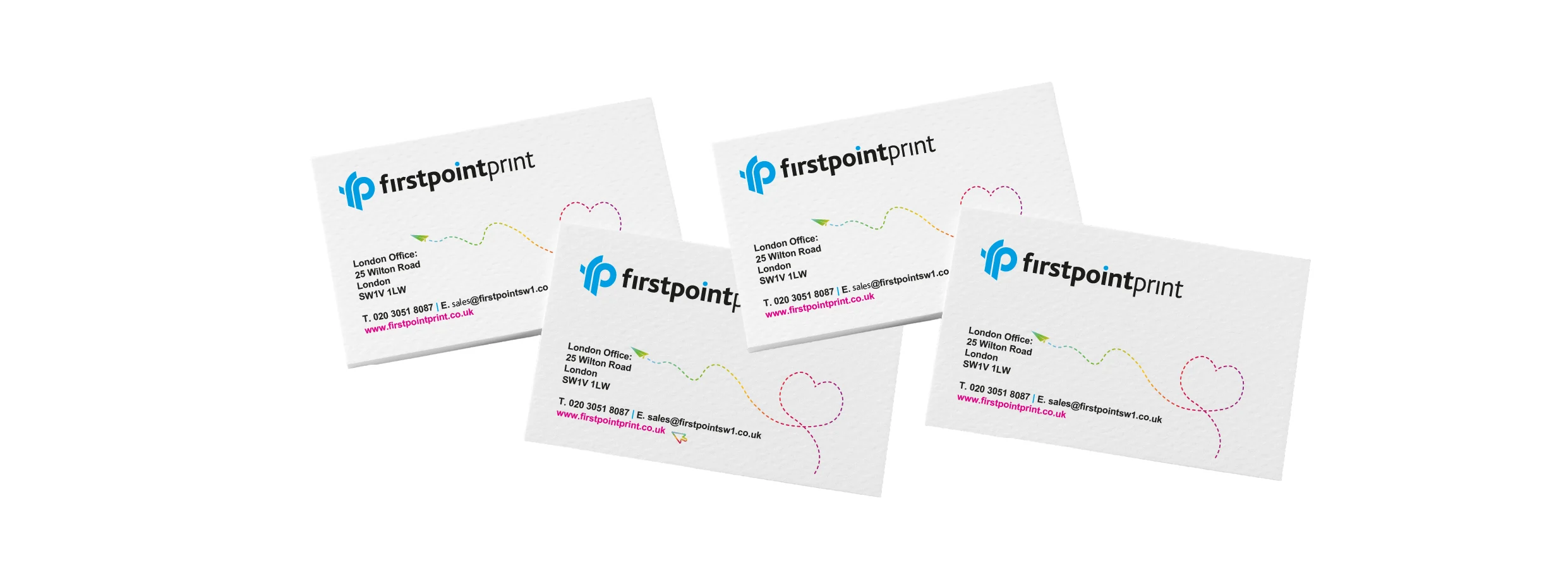
Firstpointprint produces business cards on 400gsm silk or matt stock, with gloss or matt lamination and gold or silver foil finishing options available. Take a look at our business card printing options, or get in touch if you would like some practical advice before placing an order.

See…
What we’re doing
Follow us on Instagram to see our latest projects in print!
We’re at firstpointprint_victoria